


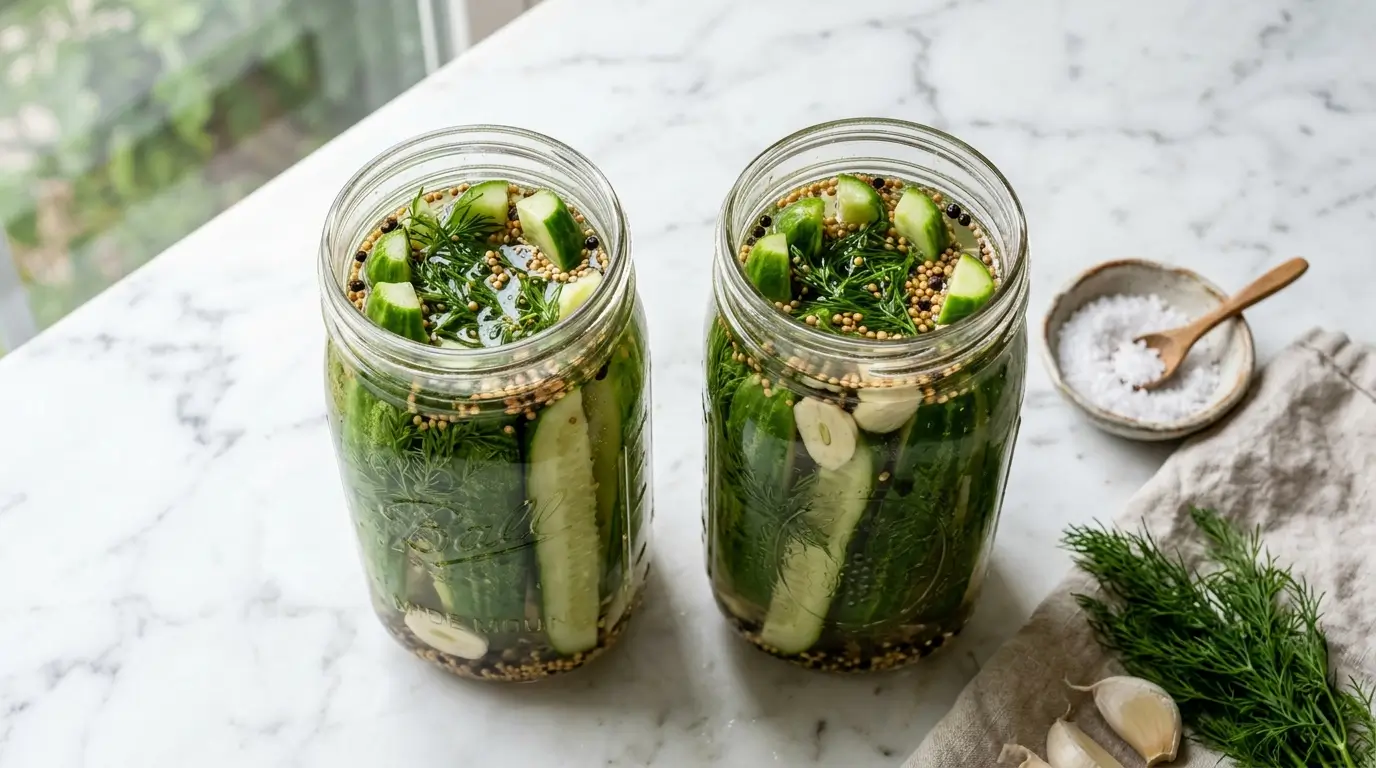
If you want the crunchiest, most flavourful homemade pickles you have ever tasted — ready in just 24 hours with no canning equipment, no sterilising jars, and no special skills required — this refrigerator pickles recipe is the only one you will ever need. According to Once Upon a Chef, all you need to make outstanding refrigerator pickles is fresh cucumbers, a simple vinegar brine, a handful of aromatics, and a jar — the fridge does all the work for you.
Table of Contents
What Are Refrigerator Pickles & Why You’ll Love Them
Refrigerator pickles — also known as quick pickles or fridge pickles — are cucumbers (or other vegetables) preserved in a vinegar-based brine and stored in the refrigerator rather than processed through traditional heat canning. Unlike shelf-stable canned pickles, refrigerator pickles are never heat processed, which means the cucumbers stay dramatically crunchier, fresher, and more vibrantly flavoured than anything you will ever find in a supermarket jar.
The beauty of refrigerator pickles is their total simplicity — there is no complicated canning process, no special equipment, no sterilised jars, and no risk of botulism from improper processing. You simply make a brine, pour it over sliced cucumbers loaded with aromatics, seal the jar, and refrigerate. Within 24 hours you have genuinely outstanding homemade pickles that taste infinitely better than store-bought and cost a fraction of the price.
What makes refrigerator pickles genuinely superior to traditionally canned pickles is texture above everything else. The heat processing required for shelf-stable canned pickles breaks down the cell structure of the cucumber and produces the soft, slightly mushy texture that defines commercial pickles. Refrigerator pickles skip heat processing entirely, preserving the cell structure completely and producing a satisfying, audible crunch in every single bite that no canned pickle can match.
Key Benefits:
- Ready in just 24 hours — no week-long waiting, no complicated process
- No canning equipment needed — just a clean jar and a fridge
- Dramatically crunchier than store-bought — no heat processing means fully intact cell structure
- Infinitely customisable — dill, garlic, spicy, sweet, bread and butter
- Works with any vegetable — cucumbers, carrots, green beans, cauliflower, asparagus
- Naturally gluten-free and vegan — the classic brine contains zero animal products
- Keeps for up to 1 month — make a big batch and enjoy all month long
🍳 Equipment You’ll Need (3 Items)
- Two clean 1-quart (1L) mason jars with lids (no need to sterilise — washing thoroughly with hot soapy water is completely sufficient for refrigerator pickles)
- Small saucepan (for heating the brine to dissolve salt and sugar — stainless steel, glass, or ceramic only; never aluminium which reacts with vinegar)
- Sharp chef’s knife and cutting board (for slicing cucumbers and aromatics into clean, uniform pieces)
How to Make Refrigerator Pickles (Best Refrigerator Pickles 2026)
Course: SidesCuisine: AmericanDifficulty: Easy8
servings20
minutes5
minutes15
kcal25
minutesThe crunchiest, most flavourful homemade pickles you will ever make — ready in just 24 hours with no canning equipment, no sterilising jars, and no special skills required. A simple vinegar brine poured over fresh cucumbers loaded with garlic, dill, and aromatics produces pickles that are infinitely crunchier and more flavourful than anything from a supermarket jar.
Ingredients
🥒 Core Ingredients:
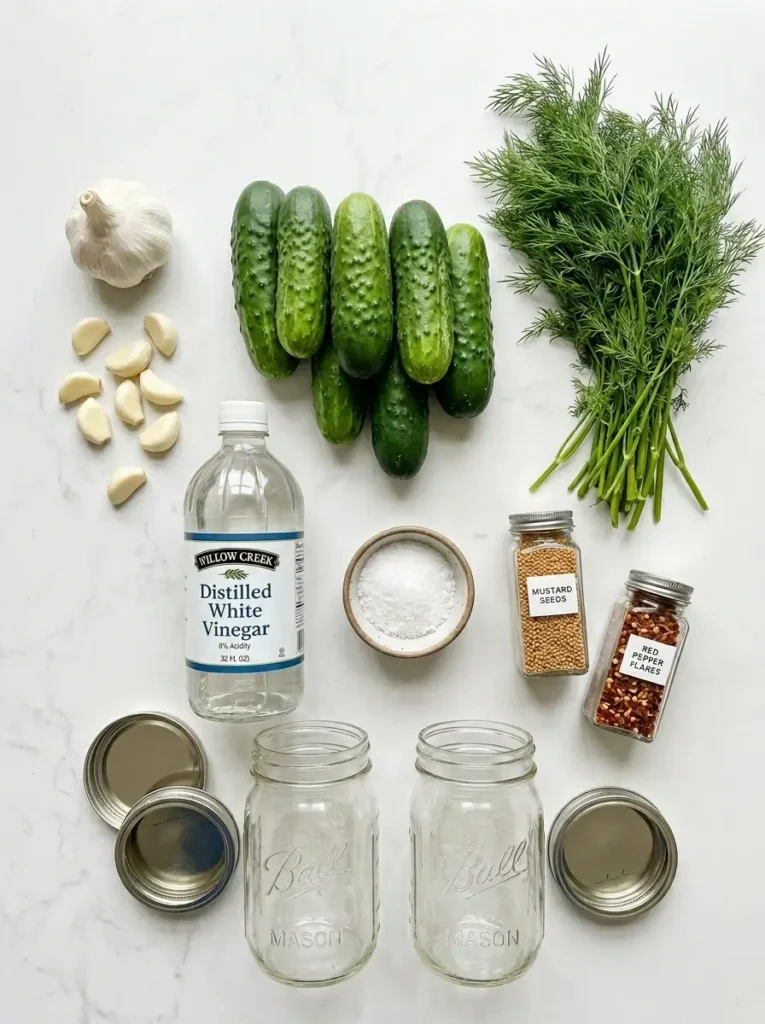
900g (2 lbs) Kirby or pickling cucumbers, both ends trimmed
4 large garlic cloves, peeled and smashed
1 large bunch fresh dill (stems and fronds)
1 tsp mustard seeds
1 tsp whole black peppercorns
½ tsp red pepper flakes (optional, for heat)
🫙 Classic Garlic Dill Brine:
1½ cups (360ml) distilled white vinegar (5% acidity)
1½ cups (360ml) cold water
1½ tbsp kosher salt (never iodised table salt)
1 tsp granulated sugar
✨ Alternative Brine Variations:
Bread & Butter — 1½ cups cider vinegar + 1 cup sugar + 1 tsp turmeric + 1 tsp mustard seeds + ½ tsp celery seeds + 1 small white onion thinly sliced
Spicy Dill — classic garlic dill brine + 1 tsp red pepper flakes + 2 fresh jalapeños thinly sliced
Quick Sweet — 1½ cups white wine vinegar + 3 tbsp honey + 1 tsp whole peppercorns + 2 bay leaves + 4 garlic cloves
Mixed Vegetable — classic garlic dill brine poured over any combination of carrots, green beans, cauliflower, asparagus, or radishes
Directions
- Wash two 1-quart (1L) mason jars thoroughly with hot soapy water. Rinse well and dry completely — no sterilisation required for refrigerator pickles.
- Trim a thin slice off both ends of each cucumber — the blossom end contains enzymes that soften pickles over time; removing both ends eliminates this completely.
- Cut cucumbers into your preferred shape — spears (halved lengthwise then halved again), coins (¼-inch rounds), or halves (lengthwise only for a chunkier pickle).
- In a small saucepan over medium heat, combine the distilled white vinegar, water, kosher salt, and sugar. Heat, stirring, until the salt and sugar are completely dissolved — approximately 2–3 minutes. Do not boil.
- Remove brine from heat and allow to cool to room temperature — never pour hot brine directly over cucumbers as it begins cooking them and destroys the crunch.
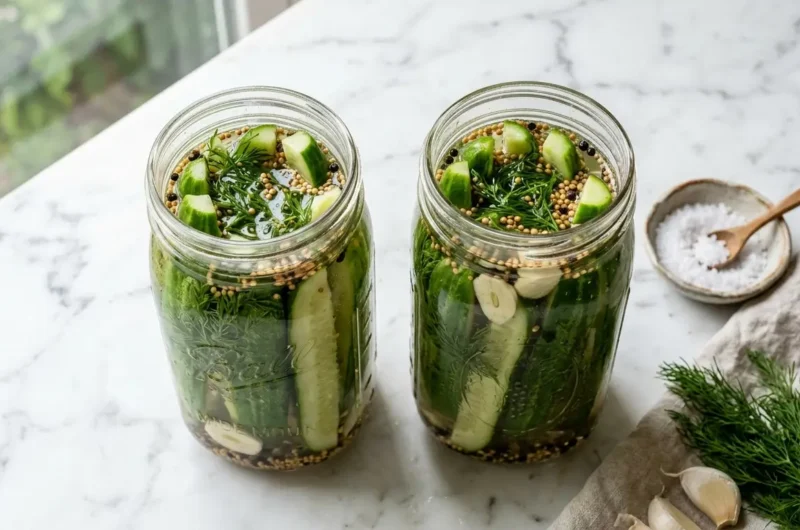
- While the brine cools, pack each mason jar as tightly as possible with cucumber pieces, distributing the garlic cloves, fresh dill, mustard seeds, peppercorns, and red pepper flakes evenly between both jars.
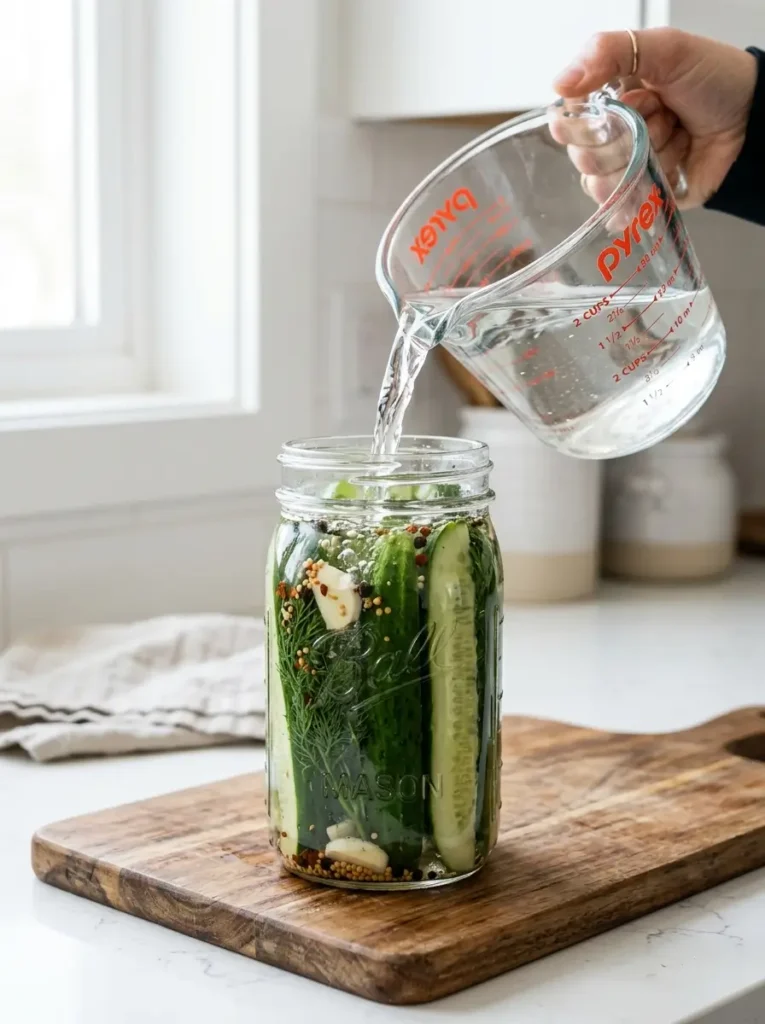
- Once the brine has cooled to room temperature, pour it evenly over the packed cucumbers in each jar, ensuring all cucumber pieces are fully submerged in brine.
- Tap each jar gently on the counter to release any air bubbles. Top up with additional brine if needed to ensure all cucumbers are fully covered.
- Seal the jars tightly with their lids and refrigerate immediately.
- Wait a minimum of 24 hours before eating — 48–72 hours produces a significantly deeper, more developed pickle flavour. The pickles continue improving throughout the full month storage period.
Recipe Video
Notes
- Always use Kirby or pickling cucumbers — Kirby cucumbers have thinner skins, fewer seeds, lower water content, and a natural crunch that regular slicing cucumbers cannot match; regular cucumbers produce softer, less satisfying pickles
- Always trim both ends — the blossom end of a cucumber contains enzymes that soften pickles over time; slicing off a thin piece from both ends is the single most important step for maximum crunch
- Always cool the brine first — adding hot brine directly to cucumbers begins cooking them, which softens their cell structure and destroys the crunch; always cool to room temperature before pouring
- Use kosher salt only — iodised table salt contains anti-caking agents that cloud the brine and affect flavour; always use kosher salt or pickling salt exclusively
- Pack jars as tightly as possible — tightly packed cucumbers stay submerged in brine, pickle more evenly, and stay crunchier throughout the entire storage period
Refrigerator Pickles Variations (5 Ways)
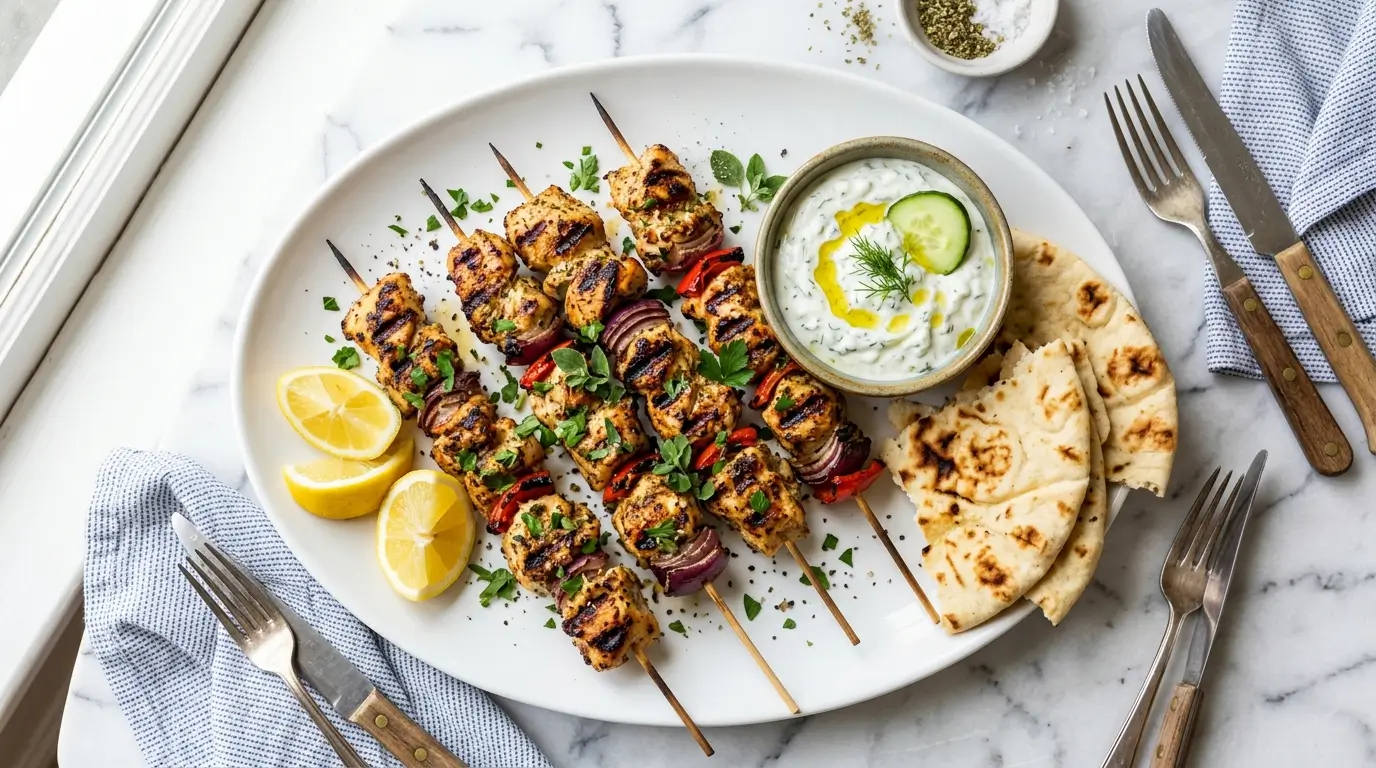
The Classic Garlic Dill version is the most universally loved and versatile — it pairs with everything from burgers and sandwiches to charcuterie boards and pairs perfectly alongside our Chicken Skewers Grilled as a bright, acidic counterpoint to the rich smoky char. The Bread & Butter variation is the most crowd-pleasing for anyone who finds classic dill pickles too sharp — the gentle sweetness and turmeric warmth make it genuinely addictive.
What To Serve With Refrigerator Pickles (Perfect Pairings)
Refrigerator pickles are one of the most versatile condiments in the kitchen — they work as a side, a topping, a snack, and a palate cleanser alongside rich, heavy dishes.
🍽️ Food Pairings:
- Grilled chicken skewers — our Chicken Skewers Grilled served alongside a jar of fresh refrigerator pickles makes a complete, beautifully balanced cookout spread
- Burgers and hot dogs — refrigerator pickles are the ultimate burger topping; the sharp vinegar tang cuts through the richness of beef and cheese like nothing else
- Pico de gallo and chips — our Pico de Gallo Recipe alongside a bowl of refrigerator pickle spears makes an outstanding appetiser spread for any gathering
- Potato salad — our Potato Salad Recipe paired with refrigerator pickles is the definitive classic American cookout combination
- Corn on the cob — our Corn on the Cob on the Grill with refrigerator pickles on the side is a perfect summer BBQ pairing
- Grilled cheese sandwiches — sliced refrigerator pickles inside or alongside a grilled cheese sandwich is one of the greatest simple lunch combinations
- Charcuterie and cheese boards — a jar of homemade refrigerator pickles on a charcuterie board elevates every other element and provides essential acidity to cut through rich meats and aged cheeses
🥛 Beverages:
- Cold beer — the classic and most natural pairing with pickles at any cookout or BBQ gathering
- Sparkling water with lemon — the effervescence and citrus complement the vinegar tang beautifully for a non-alcoholic pairing
- Bloody Mary — refrigerator pickle spears are the single greatest Bloody Mary garnish — the brine itself can even be stirred into the drink for an extraordinary dirty pickle Bloody Mary
Expert Tips for Perfect Refrigerator Pickles
✅ Always use Kirby or pickling cucumbers — Kirby cucumbers have thinner skins, fewer seeds, lower water content, and a natural crunch that regular slicing cucumbers cannot match; regular cucumbers produce acceptable but noticeably softer pickles
✅ Slice off both ends of each cucumber — the blossom end of a cucumber contains enzymes that soften pickles over time; always slice off a thin piece from both ends before cutting to prevent softening
✅ Always chill the brine before adding to cucumbers — adding hot brine directly to cucumbers begins cooking them slightly, which softens their texture; always cool the brine to room temperature or refrigerate it before pouring over the cucumbers
✅ Pack the jar as tightly as possible — the more tightly packed the cucumbers, the less they float and move in the brine; tightly packed pickles pickle more evenly and stay crunchier throughout
✅ Use kosher salt, never iodised table salt — iodised table salt contains anti-caking agents that cloud the brine and can affect flavour; always use kosher salt or pickling salt for perfectly clear, clean-tasting brine
✅ Always use distilled white vinegar at 5% acidity — the acidity percentage matters for both flavour and food safety; always check the label and use vinegar with exactly 5% acidity
✅ Taste and adjust after 24 hours — refrigerator pickles continue to develop flavour the longer they sit; taste after 24 hours and again at 48 hours to understand how the flavour evolves and find your personal preference
Storage Instructions
Make-ahead tip: Refrigerator pickles are the ultimate make-ahead condiment — make a double batch on Sunday and you have outstanding homemade pickles ready all week long. They pair perfectly with our Chicken Skewers Grilled and Corn on the Cob on the Grill for a completely prepared, stress-free summer cookout.
Nutrition Per Serving (Approximate)
| Nutrient | Amount | % Daily Value |
|---|---|---|
| Calories | 15 kcal | — |
| Carbohydrates | 3g | 1% |
| Sugar | 1g | — |
| Protein | 0g | 0% |
| Fat | 0g | 0% |
| Fibre | 0g | 0% |
| Vitamin K | 10mcg | 8% |
| Sodium | 280mg | 12% |
Based on 8 servings (approximately 3–4 spears each), Classic Garlic Dill version
Troubleshooting
Frequently Asked Questions
❓ How long do refrigerator pickles take to be ready?
Refrigerator pickles are ready to eat after a minimum of 24 hours in the fridge — at this point they are lightly pickled with a bright, fresh flavour. For a deeper, more complex pickle flavour that tastes more like a traditional deli pickle, wait 48–72 hours. The flavour continues developing throughout the full month storage period.
❓ Do I need to sterilise the jars for refrigerator pickles?
No — this is one of the great advantages of refrigerator pickles over traditional canning. Because the pickles are stored in the refrigerator rather than at room temperature, full sterilisation is not required. Simply wash your jars thoroughly with hot soapy water, rinse well, and dry completely. The refrigerator temperature combined with the acidity of the vinegar brine provides all the preservation needed.
❓ Can I reuse the brine for a second batch?
You can reuse the brine once for a second batch, but the flavour will be noticeably milder as the brine becomes diluted with cucumber water from the first batch. For best results, make a fresh batch of brine for each new batch of pickles. The used brine can also be stirred into salad dressings, marinades, or cocktails where its diluted tangy flavour is an asset rather than a limitation.
❓ What vegetables work besides cucumbers?
Almost any firm vegetable works beautifully for refrigerator pickles. The most popular alternatives are carrots (cut into sticks), green beans (left whole), cauliflower florets, asparagus spears, radishes, and jalapeños. Softer vegetables like zucchini work but produce a less crunchy result. Mix and match vegetables in the same jar for a beautiful, colourful mixed pickle that is stunning on a charcuterie board.
❓ Why are my refrigerator pickles not crunchy?
The three most common causes of soft refrigerator pickles are: using regular slicing cucumbers instead of Kirby/pickling cucumbers, not slicing off the blossom end of each cucumber, and adding hot brine directly to the cucumbers without cooling it first. All three are easy to avoid and produce dramatically crunchier pickles.